
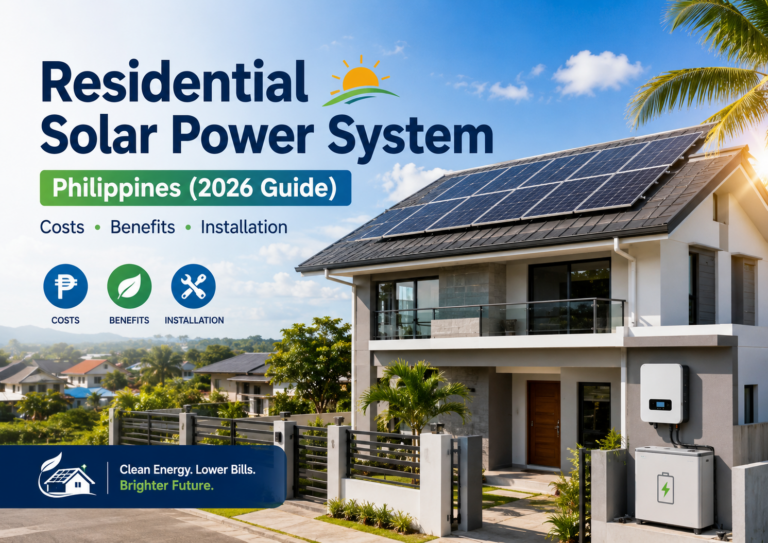
A residential solar power system is a set of rooftop solar panels, an inverter, and (optionally) a battery that generates your home’s own electricity, cutting your Meralco bill by 50%–100% depending on system size and consumption. In the Philippines, entry-level home systems start around ₱75,000, typically pay for themselves in 2–4 years, and can be registered under the government’s net metering program to earn bill credits for excess power sent back to the grid.
Why Filipino Electricity Bills Keep Climbing in 2026
If your Meralco bill has felt heavier this year, the numbers back that up. The residential rate climbed from ₱13.8161/kWh in March 2026 to ₱14.4833/kWh in June 2026 — a jump of nearly 5% in three months. Two forces are driving it:
1. A Declared National Energy Emergency
In March 2026, President Marcos signed Executive Order No. 110, declaring a State of National Energy Emergency after the conflict in the Middle East disrupted oil shipments through the Strait of Hormuz. Because the Philippines imports the vast majority of its fuel, that disruption fed directly into higher generation costs — and higher generation costs are passed straight through to your monthly bill. The emergency declaration remains in force for up to a year unless lifted earlier.
2. Record Heat, Record Demand, and Grid Red Alerts
Extreme heat pushed electricity demand past 2024’s record levels. The Luzon grid was placed on red alert for three consecutive days in May 2026 as generation capacity struggled to keep up, sending Wholesale Electricity Spot Market (WESM) prices sharply higher. Meralco has publicly said household electricity demand can rise 20–33% during the hottest months, largely from air conditioner use, which shows up directly in your generation charge.
| Month | Rate (₱/kWh) | Change vs. Prior Month |
|---|---|---|
| March 2026 | ₱13.8161 | — |
| April 2026 | ₱14.3496 | +₱0.5335 |
| May 2026 | ₱14.3345 | -₱0.0151 |
| June 2026 | ₱14.4833 | +₱0.1488 |
This is exactly the environment where a residential solar power system stops being a “nice to have” and starts being a hedge against a bill you no longer control. Every kWh your panels generate is a kWh Meralco doesn’t get to bill you for at whatever rate it announces next month.
How a Residential Solar Power System Actually Works
A home solar system has three core components:
- Solar panels — convert sunlight into DC electricity. Modern panels used in Philippine installations run 20–23% efficiency and typically carry 25-year performance warranties.
- Inverter — converts DC electricity into the AC power your appliances actually use, and (in grid-tied systems) synchronizes with Meralco’s grid.
- Battery (optional) — stores excess solar energy for use at night or during outages. Required for hybrid and off-grid systems; not required for basic on-grid systems.
The Philippines gets an average of 4.5–5.5 peak sun hours per day (slightly lower in Metro Manila during the rainy season, higher in parts of Mindanao and the Visayas), which is more than enough sunlight for a properly sized residential system to cover 50–100% of a typical home’s consumption.
On-Grid vs. Hybrid vs. Off-Grid: Which One Fits Your Home?
NuPON Solar offers all three configurations, and the right one depends on your grid reliability and budget — not just your roof size.
| System Type | How It Works | Backup During Outages? | Best For |
|---|---|---|---|
| On-Grid (Grid-Tied) | Connects directly to the Meralco grid; solar is used immediately, grid fills the gap | No | Homeowners with stable grid access who mainly want lower monthly bills and net metering eligibility |
| Hybrid | Combines solar, grid, and battery storage in one system | Yes | Homes that also want protection during brownouts or Red/Yellow Alert days |
| Off-Grid | Operates independently of the utility grid using battery storage only | Yes (full independence) | Remote properties without reliable grid access |
For most residential customers in CALABARZON, Metro Manila, and other grid-connected areas, on-grid or hybrid systems make the most financial sense because they qualify for net metering — hybrid systems layer in outage protection for a higher upfront cost.
NuPon GridSave: Residential Solar Systems by Home Size
NuPON Solar’s residential lineup is built around actual Filipino household consumption patterns rather than a one-size-fits-all package. Every system is sized against your real energy usage, peak load, and roof orientation before installation.
| System | Starting Price | Best For | Handles |
|---|---|---|---|
| NuPon GridSave 3kW | ₱135,000 | Condos, townhouses, small families, first-time solar adopters | Always-on essentials: refrigerator, WiFi router, TV, lighting |
| NuPon GridSave 6kW | ₱270,000 | Standard family homes with 1–3 air conditioning units | Aircons, washing machines, water heaters, and multiple daytime appliances |
| NuPon GridSave 10kW | ₱450,000 | Large homes, multi-story properties, and small businesses | Heavy daytime operations; hybrid- and battery-upgrade ready |
Every configuration includes professional installation, system testing and commissioning, and after-sales technical support — and each carries NuPON’s 3-year workmanship and service warranty.
How Much Can You Really Save? The 2026 Numbers
Two things determine your actual savings: how much of your solar generation you consume directly (valued at the full retail rate, currently ₱14.48/kWh for Meralco residential customers) versus how much you export to the grid (credited at a lower blended generation rate, since net metering credits only the generation portion of the bill, not distribution or transmission charges).
In practical terms, industry data shows the payback period for residential rooftop solar in the Philippines has been shortening — falling from roughly 4.0 years to about 3.1 years over the past year, as equipment costs have dropped roughly 20–30% since 2024 alongside rising electricity rates. NuPON’s own residential systems are designed for a 2–4 year return on investment, after which the household effectively runs on free daytime power for the remaining 20+ years of panel life.
The math to remember: the more of the solar power you use in real time (during the day) rather than export back to Meralco, the faster your system pays for itself, which is why correct system sizing to your actual household load, not just your roof space, matters more than buying the biggest system available.
Net Metering in the Philippines: What Changed in 2026
Net metering — the right to export excess solar power to the Meralco grid in exchange for bill credits — is guaranteed under Republic Act 9513, the Renewable Energy Act of 2008, and operationalized through ERC Resolution No. 09, Series of 2013. Here’s what’s new this year:
- Faster approvals: A April 2026 DOE circular now requires distribution utilities to approve or reject a complete net metering application within 10 working days — down from processes that previously stretched 30–60 days. LGUs must issue electrical permits within 3 working days.
- Higher capacity ceiling: The net metering cap for commercial and industrial consumers was raised from 100 kW to 1 MW. Residential systems were already effectively uncapped, since they’re sized to match household consumption.
- Multi-site net metering: Since February 2026, credits can be shared across multiple electricity accounts under the same distribution utility — useful for owners with more than one property.
- Growing adoption: As of December 2025, more than 21,000 consumers nationwide had already registered under the net metering program, and third-party grid data suggests total rooftop solar capacity nearly doubled between early 2025 and April 2026.
One important clarification: your net metering credit is not the same as your full electricity rate. It’s based on the utility’s blended generation charge — the portion of the bill tied specifically to the cost of generating power — which is why homeowners get the most value from a system sized to maximize self-consumption rather than one built purely to sell power back to the grid.
On incentives: RA 9513 also provides VAT and duty exemptions on renewable energy equipment, though these fiscal incentives are primarily structured for DOE-accredited RE developers and equipment manufacturers rather than automatically applying to every retail residential purchase. Ask your installer and, if needed, your accountant how these provisions apply to your specific transaction.
Why Homeowners Choose NuPON Solar
NuPON Solar is a division of NuPON Technology Phils. Corp. (NTPC), which has operated in the Philippines since 2000 — 25 years in the industry — with 12 branches nationwide covering Laguna, Cavite, Batangas, Subic, Manila, Clark, Baguio, and Cebu.
- One-stop service: System design, installation, financing options, and ongoing operations & maintenance under one provider.
- Engineered, not templated: Every system is sized against a real energy usage review, peak load assessment, and roof/site evaluation — not a generic package.
- Workmanship and service warranty on residential installations.
- Nationwide reach across 12 branches, with completed residential and solar-aircon projects in Laguna, Cavite, Batangas, Rizal, and beyond.
If rising Meralco rates and grid red alerts have you thinking about solar, the smartest first step is a free site assessment — a proper system should be matched to your roof, your appliances, and your actual monthly kWh usage, not sold as an off-the-shelf box.
Frequently Asked Questions
How much does a residential solar power system cost in the Philippines?
NuPON’s residential GridSave systems start at ₱135,000 for a 3kW entry-level system, ₱270,000 for a 6kW system suited to homes with aircon units, and ₱450,000 for a 10kW system for larger homes. Final pricing depends on your actual energy usage, roof condition, and whether battery storage is included.
How much can I save on my Meralco bill with solar panels?
Homeowners can typically save 50–100% of their electricity bill, depending on system size versus consumption. Savings scale with how much of your usage happens during daylight hours, when your panels are actively generating power.
What is net metering, and do I need it?
Net metering lets you export excess solar electricity to the Meralco grid in exchange for bill credits, under rights guaranteed by RA 9513. It’s optional but recommended for on-grid and hybrid systems, since it captures value from any solar power you generate but don’t use immediately.
How long does it take to get net metering approved in 2026?
As of an April 2026 DOE circular, distribution utilities must approve or reject a complete net metering application within 10 working days, and LGUs must issue electrical permits within 3 working days — a major improvement from the 30–60 day timelines common in prior years.
How long do residential solar panels last?
Solar panels typically last 25 years or more with proper maintenance, while inverters and other components vary by model. NuPON provides a 3-year equipment warranty and ongoing after-sales technical support.
What’s the difference between hybrid and on-grid solar systems?
A hybrid system adds battery storage so your home retains power during outages or grid Red Alert days. An on-grid (grid-tied) system connects directly to Meralco without battery backup, which lowers upfront cost but means no power during an outage.
Ready to See What Solar Could Save You?
NuPON Solar offers free site assessments for homeowners across Laguna, Cavite, Batangas, Metro Manila, and other service areas nationwide. Get a system sized to your actual electricity usage — not a generic package — and start reducing your exposure to Meralco’s monthly rate changes.